
Close your eyes and you can almost hear it: a rolling, tumbling drumbeat, a bright electric guitar, and a skinny kid from Texas hiccuping a girl’s name over and over. “Peggy Sue” came out in the fall of 1957, and for millions of American teenagers it sounded like the future.
In this Artist Spotlight, we look at the short, brilliant life of Buddy Holly through his best-loved song. We cover his West Texas roots, the little studio in New Mexico where the magic happened, the real Peggy Sue, and how a 22-year-old changed rock and roll forever. You can watch him perform it on The Ed Sullivan Show at the end of the article.
▶️ Want to see Buddy in action? Scroll down. The performance clip is waiting at the end of the article.
A Lubbock Boy Called “Buddy”
Charles Hardin Holley was born on September 7, 1936, in Lubbock, Texas, the youngest of four children. Everyone called him “Buddy” from the start. It was a musical family, and young Buddy grew up on Hank Williams, Bill Monroe, Bob Wills and the Carter Family. He tried piano, then switched to guitar after seeing a classmate play and sing on the school bus. His parents bought him an acoustic guitar from a local pawnshop.
In 1955, the same year he graduated from Lubbock High School, Buddy saw Elvis Presley perform in town. He opened for Elvis three times that year, and his music swung from country and western toward rock and roll. If you have read our story of Elvis Presley’s “Jailhouse Rock”, you know what kind of fire Elvis was lighting across the country at the time.
A False Start, Then Clovis
A Nashville scout spotted Buddy opening for Bill Haley & His Comets, and Decca Records signed him in early 1956. The contract misspelled his surname as “Holly,” and the name stuck. But the Nashville sessions did not go well. Buddy had little say over the musicians or the arrangements, and the singles went nowhere. In January 1957, Decca let him go.
So Buddy drove across the state line to Clovis, New Mexico, where producer Norman Petty ran a small studio. With drummer Jerry Allison, bassist Joe B. Mauldin and rhythm guitarist Niki Sullivan, he cut a new version of “That’ll Be the Day,” a line the boys had picked up from John Wayne in The Searchers. Released under the band name the Crickets, it topped the American and British charts in the fall of 1957.
The Story Behind “Peggy Sue”
“Peggy Sue” started life with a different name. It was first called “Cindy Lou,” after Buddy’s niece. Then Jerry Allison asked for a change. He and his high school sweetheart, Peggy Sue Gerron, had just broken up, and he hoped a song might win her back. It worked. The two married in 1958, though they divorced years later.
Peggy Sue Gerron later wrote that she first heard the song at a concert in Sacramento in 1957, and that she was “so embarrassed, I could have died.”
That Rolling Drumbeat
Listen closely and you will notice that the drums drive the whole record. Allison plays nonstop paradiddles, a rapid rudiment drummers learn early on, and Norman Petty made them swell and fade in real time at the mixing desk. Add Buddy’s hiccuping vocal and a sharp guitar break, and you get one of the most recognizable sounds of the 1950s.
For years only Allison and Petty were listed as the writers. At Allison’s insistence, Buddy was finally credited as a co-writer after his death.
A Hit, a Name Game and Ed Sullivan
Coral Records released “Peggy Sue” on September 20, 1957, with “Everyday” on the B-side. By October it had reached No. 3 on Billboard’s pop chart and No. 2 on the R&B chart.
Here is a detail that confused fans even then. Petty released some records as “the Crickets” and others under Buddy’s own name, figuring disc jockeys would happily play more songs by what looked like two different acts. Buddy himself said in a 1957 radio interview that he did not know why “Peggy Sue” went out under his name. It was the same band either way.
On December 1, 1957, Buddy Holly and the Crickets played “That’ll Be the Day” and “Peggy Sue” on The Ed Sullivan Show. That is the performance at the end of this article, and it is a rare chance to see the young band in action, bringing West Texas rock and roll into America’s living rooms on a Sunday night. It was also one of the last shows with Niki Sullivan, who left the group soon afterward, tired of the constant touring.
The Glasses, the Guitar and the Look
Early on, Buddy and the band wore plain business suits. Then they met the Everly Brothers, who took them shopping for Ivy League clothes in New York and told Buddy to swap his old-fashioned glasses for bold horn-rims. Teenagers across America soon asked their optometrists for the same frames. We still call them “Buddy Holly glasses.”
His Fender Stratocaster became just as famous. With two guitars, bass and drums, Buddy and the Crickets helped set the standard lineup for rock bands for decades to come.
The Day the Music Died
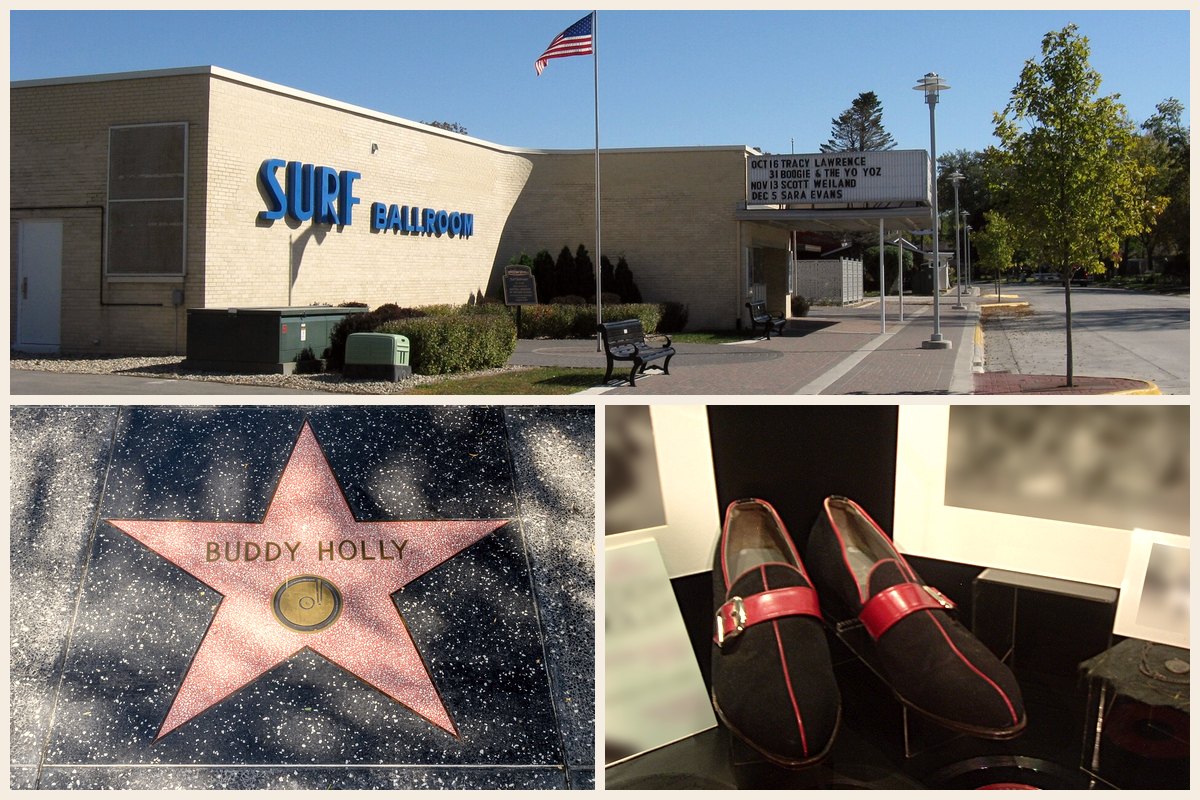
In January 1959, Buddy set out on the Winter Dance Party tour of the Midwest, with a new band that included a young Waylon Jennings on bass. The buses were unheated and kept breaking down in the freezing cold. After a show at the Surf Ballroom in Clear Lake, Iowa, Buddy chartered a small plane to reach the next stop.
Shortly after 1:00 a.m. on February 3, 1959, the plane crashed in a cornfield, killing Buddy Holly, Ritchie Valens, J. P. “The Big Bopper” Richardson and pilot Roger Peterson. Buddy was 22. He had been married to María Elena Santiago for just six months. In 1971, Don McLean’s “American Pie” called it “the day the music died,” and the name stuck.
Why Buddy Holly Still Matters
For a career that lasted barely three years, the influence is staggering. John Lennon and Paul McCartney studied his records, and their insect-themed band name was inspired by the Crickets. The Rolling Stones had a hit with his “Not Fade Away.” Bob Dylan, Eric Clapton and Elton John all count him as an influence. In 1986 he was among the first artists inducted into the Rock and Roll Hall of Fame, and “Peggy Sue” entered the Grammy Hall of Fame in 1999.
Where to Start: A Buddy Holly Listening Guide
- The essential albums: The “Chirping” Crickets (1957) and Buddy Holly (1958), which includes “Peggy Sue.”
- Play next: “That’ll Be the Day,” “Everyday,” “Oh, Boy!,” “Not Fade Away,” “Rave On” and “Words of Love.”
- The sequel: “Peggy Sue Got Married,” which Buddy recorded alone with his guitar in his New York apartment in December 1958.
- On screen: The Buddy Holly Story (1978), which earned Gary Busey an Oscar nomination, though Buddy’s friends and family criticized it for inaccuracies.
- More from the era: explore our 50s Rock & Roll and Rock collections, including our tribute to Chuck Berry at 100.
Fun Facts About Buddy Holly and “Peggy Sue”
- As a boy, Buddy “played” violin in a talent show with his brothers. His brother greased the bow so it would make no sound, and they still won.
- Buddy and the Crickets were reportedly the first white act booked at Harlem’s Apollo Theater, in August 1957.
- The Beach Boys, John Lennon and Waylon Jennings all recorded “Peggy Sue.”
- Buddy’s glasses were presumed lost after the 1959 crash until they turned up in 1980, in a storage area of the Cerro Gordo County courthouse in Iowa.
- A statue of Buddy playing his Fender stands at the heart of the Walk of Fame in Lubbock.
Buddy Holly and “Peggy Sue” Quick Facts
| Born | September 7, 1936, Lubbock, Texas |
| Died | February 3, 1959, near Clear Lake, Iowa |
| Song | “Peggy Sue” |
| Credited writers | Jerry Allison, Norman Petty and (later) Buddy Holly |
| Recorded at | Norman Petty’s studio, Clovis, New Mexico |
| Released | September 20, 1957 (Coral Records) |
| Billboard peak | No. 3 pop, No. 2 R&B |
| Album | Buddy Holly (1958) |
| Ed Sullivan performance | December 1, 1957 |
| Honors | Grammy Hall of Fame (1999); Rock and Roll Hall of Fame (1986) |
Sources
- “Peggy Sue” on Wikipedia (with its cited sources, including Peggy Sue Gerron’s memoir and Rolling Stone)
- Buddy Holly on Wikipedia
- Buddy Holly at the Rock & Roll Hall of Fame
Photo Credits
- Featured image: Buddy Holly statue, Lubbock, Texas, 2014 by Carol M. Highsmith (Library of Congress), public domain, via Wikimedia Commons
- Featured image: Buddy Holly’s glasses, Buddy Holly Center, Lubbock by John W. Schulze, CC BY 2.0, via Wikimedia Commons
- Featured image: Norman Petty Recording Studios, Clovis, New Mexico, 2008 by Wordbuilder, CC BY 3.0, via Wikimedia Commons
- Featured image: Buddy Holly’s Fender Stratocaster, Buddy Holly Center, Lubbock by John W. Schulze, CC BY 2.0, via Wikimedia Commons
- In-article image: Surf Ballroom, Clear Lake, Iowa, 2015 by Joe Passe, CC BY-SA 2.0, via Wikimedia Commons
- In-article image: Buddy Holly’s star on the Hollywood Walk of Fame, 2012 by Dietmar Rabich, CC BY-SA 4.0, via Wikimedia Commons
- In-article image: Buddy Holly’s shoes, Buddy Holly Center, Lubbock by John W. Schulze, CC BY 2.0, via Wikimedia Commons