Before the music even starts, there’s a voice. Someone in the studio calls out a take number, Davy Jones asks what number it is, and the whole band shouts “7A!” back at him. Then comes that rolling piano, and one of the happiest records of the 1960s begins.
“Daydream Believer” hit No. 1 in America in December 1967, just as the Monkees’ TV show was in its second season and the band was finally playing on its own records. For millions of kids who rushed home to watch them on NBC, it was the sound of that whole sunny, slightly zany era. Here are ten things worth knowing about it. The official video is waiting for you at the end of the article.
▶️ Please scroll down for the video. The Monkees are waiting at the end of the article!
1. A Folk Singer Wrote It About an Ordinary Day
The song was written by John Stewart, who had spent 1961 to 1967 in the Kingston Trio. He wrote it as the third in a little trilogy of songs about suburban life. “I remember going to bed thinking, ‘What a wasted day, all I’ve done is daydream,’” he recalled. “And from there I wrote the whole song.” Funny enough, he never thought it was one of his best.
2. Two Other Groups Said No
Stewart first offered it to the folk-pop groups We Five and Spanky and Our Gang. Both passed. Then, at a party at Hoyt Axton’s home in Laurel Canyon, producer Chip Douglas mentioned that he was now working with the Monkees and asked if Stewart had anything that might suit them. Stewart played him “Daydream Believer.”
3. The Monkees Actually Played on This One
The Monkees were famously assembled for television in 1965 by producers Bob Rafelson and Bert Schneider, and on their earliest hits, studio musicians did most of the playing. By 1967 the band had fought for and won control of their records. On “Daydream Believer,” Davy Jones sings lead, Micky Dolenz adds harmonies, Michael Nesmith plays electric guitar, and Peter Tork came up with and played that famous piano introduction. Jazz trumpeter Shorty Rogers wrote the orchestral arrangement.
4. “7A” Was Just a Take Number
That opening bit of studio chatter has puzzled fans for decades. It’s simply the take number being called out on the session. Davy didn’t catch it, asked again, and the others yelled it back. He then cracked a joke about being short. Jones later said he was tired and grumpy that day, felt the song was in the wrong key for him, and that you can hear a hint of annoyance in his vocal. If so, it only makes the record more charming.
5. The Record Label Changed One Word
Stewart’s original lyric said “now you know how funky I can be.” RCA, which distributed the Monkees’ records, wasn’t having it, and insisted on “happy” instead. Stewart objected, since the change flipped the meaning of the line, but he gave in because he could tell the song might be a hit. Dolenz later explained that “funky” was considered a little too suggestive for the Monkees in 1967.
6. It Was Supposed to Be a B-Side
According to Fred Bronson’s The Billboard Book of Number One Hits, “Daydream Believer” was first planned as the flip side of a Nesmith-sung song called “Love Is Only Sleeping.” A week before release, the European masters for that song weren’t ready, but the ones for “Daydream Believer” were. So it moved to the A-side, with the band-written “Goin’ Down” on the back.

7. TV Made It a Hit Before It Was Even in Stores
The band performed the song on an episode of The Monkees that aired on October 9, 1967, and it turned up in more episodes after that. The single reached No. 1 on the Billboard Hot 100 on December 2, 1967, and stayed there for four weeks, until the Beatles’ “Hello, Goodbye” took over. It was the Monkees’ third and final American No. 1, after “Last Train to Clarksville” and “I’m a Believer.” In Britain it reached No. 5.
8. It Became Davy’s Favorite
Despite his grumbling in the studio, Davy Jones came to name “Daydream Believer” as his favorite Monkees song. Jones died of a heart attack in February 2012, at 66, not long after the band’s 45th anniversary tour. With Peter Tork’s passing in 2019 and Michael Nesmith’s in 2021, Micky Dolenz became the last surviving Monkee.
9. It Never Stopped Coming Back
Anne Murray’s gentle 1979 cover went to No. 3 on the country chart and No. 12 on the Hot 100. In 1986, when an MTV marathon of the old TV show sparked a huge Monkees revival, Arista re-released “Daydream Believer” with a new, heavier drum track. Stewart cut his own version in 1971, and he said in 2006 that the song’s royalties had “kept me alive for all these years.”
10. The Monkees Family Tree Runs Into the ’80s
Here’s a fun bit of trivia for music video fans. Monkees co-creator Bob Rafelson and Michael Nesmith teamed up again in 1983 to make the colorful street-party video for Lionel Richie’s “All Night Long”. Nesmith had become a true music video pioneer by then. You could say the Monkees helped invent the music video twice: once on TV in 1966, and again in the MTV age.
How to Enjoy It Today
- Start with the album. The song appears on The Birds, The Bees & The Monkees (1968), which also includes “Valleri.”
- Go back a step. Headquarters and Pisces, Aquarius, Capricorn & Jones Ltd. (both 1967) show the band playing and producing with Chip Douglas.
- Hear the writer’s version. John Stewart’s own 1971 recording on The Lonesome Picker Rides Again is slower and more grown-up.
- If you like this, try: the Beach Boys’ “Good Vibrations” and the rest of our 60s Classics and Pop sections.
“Daydream Believer” Quick Facts
| Artist | The Monkees |
| Written by | John Stewart |
| Lead vocal | Davy Jones |
| Producer | Chip Douglas |
| Album | The Birds, The Bees & The Monkees (1968) |
| Label | Colgems (distributed by RCA) |
| B-side | “Goin’ Down” |
| Billboard Hot 100 peak | No. 1 for four weeks (December 1967) |
| UK peak | No. 5 |
| Notable cover | Anne Murray (1979) |
Looking for more countdowns like this one? Head over to our Top Lists page.
Sources
- “Daydream Believer” on Wikipedia (with its cited sources, including The Billboard Book of Number One Hits)
- The Monkees on Wikipedia
- The Birds, The Bees & The Monkees on Wikipedia
- Songfacts: “Daydream Believer” by the Monkees
Photo Credits
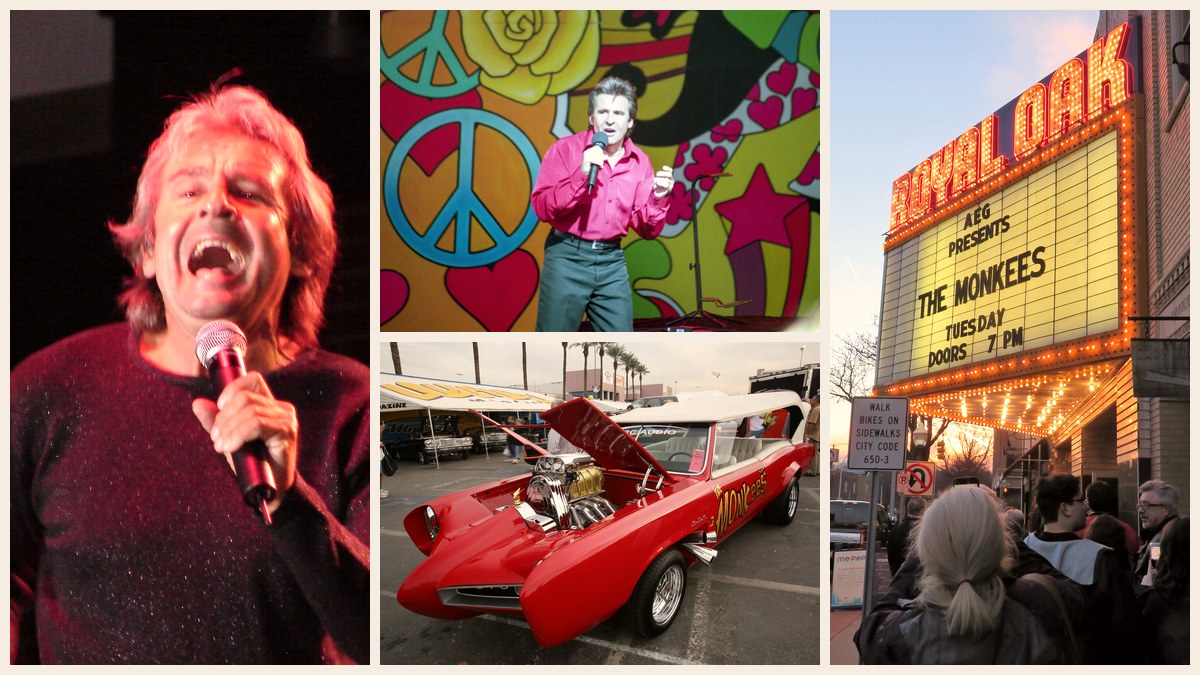
- Featured image: Davy Jones performing in Geneva, Illinois, 2006 by Karla Kaulfuss, CC BY 2.0, via Wikimedia Commons
- Featured image: Davy Jones at the Epcot Flower Power concert series, 2000 by Steven Miller, CC BY 2.0, via Wikimedia Commons
- Featured image: The Monkeemobile at the 2006 SEMA Show, Las Vegas by Espsko, CC BY 2.0, via Wikimedia Commons
- Featured image: The Monkees on the Royal Oak Music Theater marquee, 2019 by GabboT, CC BY-SA 2.0, via Wikimedia Commons
- In-article image: Micky Dolenz in Central Park, New York City, 2007 by HomecomingQueenEmily, CC BY-SA 4.0, via Wikimedia Commons
- In-article image: Michael Nesmith at the Somerville Theater, 2013 by Michael Borkson, CC BY 2.0, via Wikimedia Commons
- In-article image: Davy Jones in concert at Mohegan Sun, 2010 by Michael Borkson, CC BY 2.0, via Wikimedia Commons