Most of us can’t tell you who won Super Bowl XXV without looking it up. (It was the New York Giants, 20 to 19, after Buffalo’s last-second field goal sailed wide right.) But millions of Americans can still tell you exactly how they felt before the kickoff, when Whitney Houston walked onto the field at Tampa Stadium on January 27, 1991, and sang “The Star-Spangled Banner.”
It lasted a little over two minutes. It became a hit single, raised money for military families, returned to the charts ten years later, and is still called the gold standard of anthem performances. In this Iconic Performances feature, we look at how that rendition came together, what happened on the day, and why it still gives people goosebumps. The official recording is waiting for you at the end of the article.
▶️ Want to listen first? Scroll down. The official audio of Whitney’s anthem is at the end of the article.
A Country on Edge
It’s hard to overstate how tense that week felt. Iraq had invaded Kuwait in August 1990, and the U.S.-led air campaign of the Gulf War began on January 17, 1991, just ten days before the game. Many Americans worried about retaliation at home, and Tampa was treated as a possible target. SWAT teams patrolled the stadium, the Goodyear Blimp was grounded and Super Bowl parties were postponed. According to the NFL’s Jim Steeg, President George H. W. Bush insisted the anthem tradition go ahead.
Whitney, meanwhile, was at the height of her fame. The NFL had announced back in November 1990 that she would sing. It wasn’t the first time the league had asked; scheduling on her Moment of Truth World Tour had kept her from singing at an earlier Super Bowl.
Building a Slower, Soulful Anthem
Whitney took her inspiration from an unexpected place: Marvin Gaye’s slow, soulful anthem at the 1983 NBA All-Star Game. “It wasn’t rushed, he was able to take his time,” she told her musical director, Rickey Minor, who produced the session. Bassist and arranger John Clayton built the arrangement, and the Florida Orchestra, led by conductor Jahja Ling, played it.
The key change was the rhythm. The anthem is traditionally sung in 3/4 time, like a waltz. Whitney’s version moves it into a steady 4/4, the meter of gospel and R&B, and drops the key from B-flat to A-flat. That gave her more room inside each line. Minor has said she recorded her vocal after hearing the track once, essentially in a single take.
The Notes Everyone Remembers
Listen for the end. On the word “free,” Whitney holds the note and then leaps above it with a little two-note flourish she reportedly invented on the spot in the recording booth. A few seconds later, she sustains “brave” for around 12 seconds. Writer Cinque Henderson of The New Yorker described that high note on “free” ringing out “like a bell.”
The NFL Almost Said No
Not everyone loved it at first. When league executives heard the tape in mid-January, they reportedly called it “too slow” and hard to sing along with, and asked if it could be redone. Minor later recalled that he was even asked to record a standard version as a backup. Whitney’s father and manager, John Houston, gave the league a short answer: there would be no re-recording. The NFL let it stand.
January 27, 1991: Two Minutes in Tampa
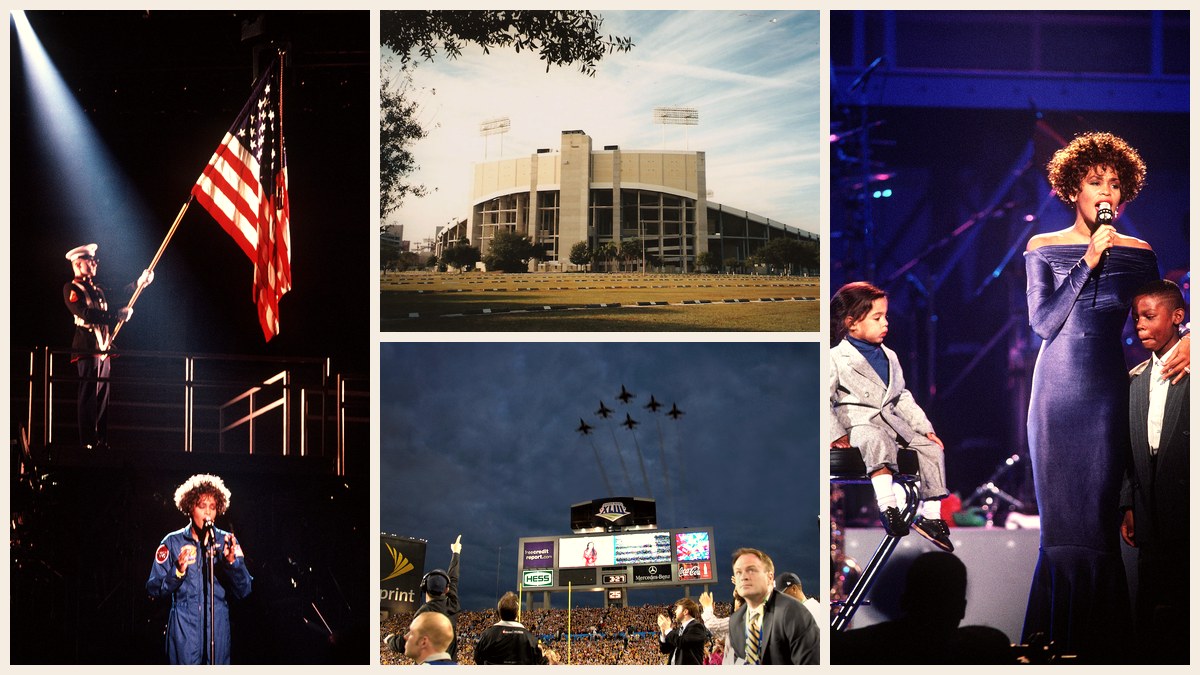
The weather in Tampa turned cool that day, so Whitney swapped the black cocktail dress she’d planned for a white Le Coq Sportif tracksuit, a matching white headband and red-and-white Nike Cortez sneakers. It turned out to be one of the most recognizable outfits in music history. A wax figure of her in that look now stands at Madame Tussauds in Washington, D.C.
Introduced by broadcaster Frank Gifford, she sang in front of 73,818 fans waving small American flags, while ABC’s cameras cut between her face and troops saluting. As she raised her arms on the final note, four F-16 fighter jets from MacDill Air Force Base roared overhead. The broadcast reportedly reached more than 115 million viewers in the U.S. and around 750 million worldwide. Gifford later called it “the most electric moment that I have ever seen in sports.”
Was It Live?
Here’s the part that surprises people. For safety and sound reasons, the NFL played Whitney’s studio recording over the stadium speakers, a standard practice at big outdoor events. Accounts differ on the details, but Rickey Minor confirmed in 2012 that Whitney really was singing live on the field while the audience heard the pre-recorded track. As Super Bowl engineer Larry Estrin put it, “she sang her heart out.” Either way, every note you hear is Whitney’s own voice.

From Pregame to Pop Charts
The phones started ringing almost immediately. According to Clive Davis, Arista Records was flooded with calls from people who wanted to buy it, and radio stations were playing tapes recorded off the TV broadcast. Arista released the audio single on February 12, 1991, backed with Whitney’s version of “America the Beautiful,” followed by a video single. All of the proceeds, $531,650, went to the American Red Cross Gulf Crisis Fund, and Whitney was named to the Red Cross Board of Governors.
The single debuted at No. 32 on the Billboard Hot 100 and climbed to No. 20, while the video single went to No. 1 on Billboard’s music video chart. It sold 750,000 copies in its first eight days, the fastest-selling single in Arista’s history at that time. Two months after the Super Bowl, on March 31, 1991, Whitney sang for returning troops and their families in the HBO concert special Welcome Home Heroes with Whitney Houston, the event pictured above.
A Second Life After 9/11
Ten years later, the song meant something new. After the September 11 attacks, Whitney agreed to reissue it, with proceeds going to the New York firefighters’ relief fund and the Fraternal Order of Police. On the Billboard chart dated October 27, 2001, it peaked at No. 6, making Whitney the first artist to take the national anthem into the top 10 since the Hot 100 began in 1958. It was also certified Platinum and became her final top-10 hit during her lifetime.
Why It Still Gives Us Chills
Plenty of great singers have performed the anthem since, and Whitney’s version is still the one they are all measured against. Billboard ranked it No. 1 on its 2023 list of the best Super Bowl anthems, and Rolling Stone has put it at the top of its own rankings more than once. But the rankings don’t really explain it. What people remember is the moment: a frightened country, a young woman in a white tracksuit, and a voice that made everyone stand a little straighter. Few songs captured a moment in the early ’90s quite like it; you’ll find more from that decade in our 90s Throwback section.
Listening Tips
- Hear the inspiration. Look up Marvin Gaye’s 1983 NBA All-Star Game anthem, then play Whitney’s version. You’ll hear exactly what she borrowed and what she made her own.
- Flip the single. Her gospel-flavored “America the Beautiful,” the original B-side, is a lovely companion piece.
- Find it on an album. The anthem was included on the U.S. edition of Whitney: The Greatest Hits (2000), a great one-stop collection of her best work.
- Go back to where it began. Her 1985 debut, Whitney Houston, is still the best place to start with her studio albums. For more soulful voices, browse our Soul & R&B section.
Super Bowl XXV Anthem Quick Facts
| Performer | Whitney Houston |
| Event | Super Bowl XXV, Tampa Stadium, Florida |
| Date | January 27, 1991 |
| Orchestra | The Florida Orchestra, conducted by Jahja Ling |
| Arranger | John Clayton |
| Producer | Rickey Minor |
| Single release | February 12, 1991 (Arista Records) |
| Hot 100 peak | No. 20 (1991); No. 6 (2001 reissue) |
| RIAA certification | Platinum (2001) |
| Charity | American Red Cross Gulf Crisis Fund (1991); 9/11 relief funds (2001) |
Sources
- “The Star Spangled Banner” (Whitney Houston recording) on Wikipedia (with its cited sources, including Billboard, Rolling Stone, The New Yorker and the St. Petersburg Times)
- Super Bowl XXV on Wikipedia
- Billboard: Super Bowl’s Top 11 National Anthem Performances (2023)
- Rolling Stone: The Most Memorable Super Bowl National Anthems
- RIAA Gold & Platinum database: Whitney Houston
Photo Credits
- Featured image: Whitney Houston sings “The Star-Spangled Banner” at Welcome Home Heroes, 1991 by PH2 Mark Kettenhofen, U.S. Navy, Public domain, via Wikimedia Commons
- Featured image: Tampa Stadium, “The Big Sombrero” by zeng8r, CC BY 3.0, via Wikimedia Commons
- Featured image: U.S. Air Force Thunderbirds flyover during the anthem at Super Bowl XLIII in Tampa, 2009 by Staff Sgt. Bradley Lail, U.S. Air Force, Public domain, via Wikimedia Commons
- Featured image: Whitney Houston performs “Greatest Love of All” at Welcome Home Heroes, 1991 by PH2 Mark Kettenhofen, U.S. Navy, Public domain, via Wikimedia Commons
- In-article image: Whitney Houston greets a sailor at Welcome Home Heroes, 1991 by PH2 Mark Kettenhofen, U.S. Navy, Public domain, via Wikimedia Commons
- In-article image: Whitney Houston and dancers perform “My Name Is Not Susan” at Welcome Home Heroes, 1991 by PH2 Mark Kettenhofen, U.S. Navy, Public domain, via Wikimedia Commons