
Think back to the early summer of 1984. Car windows down, the radio turned up, and out of the speakers comes a bright synthesizer riff, a drumbeat you could set your watch by, and a voice that sounds like it has been gargling gravel since 1973. “Dancing in the Dark” was everywhere that year, and for a lot of us it was the moment Bruce Springsteen went from being “that guy from New Jersey my older brother liked” to the biggest rock star in America.
It is a funny song when you listen closely. Under the upbeat groove is a man who is bored, restless and fed up with himself. In this Rock feature we look at how the song was written in a single night, how director Brian De Palma filmed the famous video, the records it set, and which versions and albums are worth your time today. The official video is waiting for you at the end of the article.
▶️ Please scroll down for the video. It’s waiting for you at the end of the article!
A Hit Written in One Night
By early 1984, Springsteen and the E Street Band had recorded dozens of songs for what would become Born in the U.S.A. His manager and co-producer Jon Landau still felt something was missing: a clear first single. According to Dave Marsh’s book Glory Days, Springsteen did not take the suggestion well. He reportedly told Landau that he had already written seventy songs, and if Landau wanted another one, he could write it himself.
Then he went back to his hotel room and wrote “Dancing in the Dark” that same night. The frustration shows in every line. The song is about feeling stuck, tired of your own reflection and desperate for a spark, which was close to Springsteen’s own mood after the success of The River and the pressure of trying to write a hit on demand.
Inside The Hit Factory
The band cut six takes on February 14, 1984, at The Hit Factory in New York City. Getting the sound right took far longer: the track went through 58 mixes before work wrapped on March 8, 1984. The lineup was classic E Street, with Springsteen on vocals and guitar, Roy Bittan on synthesizer, Clarence Clemons on saxophone, Garry Tallent on bass and Max Weinberg on drums.
That synthesizer surprised some longtime fans. At the time, Cash Box called the song “classic Springsteen: gutsy vocals set to a hard-driving backbeat,” and singled out the synth as an added surprise. Looking back, it was a smart fit for 1984 radio, when synth-pop ruled the airwaves and MTV was turning musicians into faces as well as voices.
Brian De Palma and the Saint Paul Video
For the music video, Columbia went big: Brian De Palma, the director of Carrie and Scarface. Instead of a moody story, De Palma made a straight concert clip, filmed at the Saint Paul Civic Center in Saint Paul, Minnesota, on June 28 and 29, 1984.
The first night was a dedicated video shoot. The second night was the opening show of the Born in the U.S.A. Tour, and the band played “Dancing in the Dark” twice during the concert so De Palma could get every shot he needed. Springsteen performs without a guitar, which leaves his hands free for the moment everyone remembers: near the end, he reaches into the crowd and pulls a young woman up to dance with him.
That fan was Courteney Cox, then a young actress who had appeared on the soap opera As the World Turns, years before Friends made her a household name. De Palma had told Springsteen she was the one to pick, but Springsteen thought she was simply a pre-selected fan and only learned afterward that she was a professional actress brought in from New York. Cox has said she was one of several people he could have chosen, and that she was secretly hoping he would not pick her.
There was more to the original plan. De Palma also shot vignettes of Cox and her friends getting ready for the concert, but that storyline was cut, leaving the simple, sweaty performance we know. It worked. In September 1985, the clip won the MTV Video Music Award for Best Stage Performance. Actor Alfonso Ribeiro later said Cox’s shy little dance helped inspire “The Carlton,” his famous move on The Fresh Prince of Bel-Air.
Chart Run and Awards
“Dancing in the Dark” was released ahead of the album, and the 12-inch single came out on May 9, 1984. It entered the Billboard Hot 100 at No. 36 on May 26, 1984. From June 30 it spent four weeks stuck at No. 2, held off first by Duran Duran’s “The Reflex” and then by Prince’s “When Doves Cry.” It did reach No. 1 on the Cash Box Top 100 for two weeks, and topped Billboard’s Top Tracks rock chart for six weeks.
The song was the first of a record-tying seven Top 10 singles from Born in the U.S.A., an album that has sold more than 30 million copies worldwide and was certified 17 times platinum by the RIAA in 2022. “Dancing in the Dark” also earned Springsteen his first Grammy Award, for Best Rock Vocal Performance, Male, in 1985, and Rolling Stone readers voted it Single of the Year for 1984.
There was even a dance-floor detour. Producer Arthur Baker remixed the track into the 12-inch “Blaster Mix,” Springsteen’s first try at club play. It reached No. 7 on Billboard’s dance club chart and was the best-selling 12-inch single in the United States in 1984.
Why It Still Hits Home
Plenty of 1984 hits sound like time capsules now. “Dancing in the Dark” still feels personal, because the feeling at its heart never goes out of style. Who has not stared in the mirror on a gray Tuesday and wanted something, anything, to change? Springsteen wraps that restlessness in a beat you can dance to, and that mix of joy and frustration is very much his trademark.
On stage, the song became a ritual. During the 2012 Wrecking Ball Tour, fans were invited up to dance just as Cox did, and Springsteen’s mother, Adele, took a turn at the Wells Fargo Center in Philadelphia. In 2024, English football fans turned the chorus into a chant for midfielder Phil Foden during Euro 2024, sending the original recording back into the UK singles chart at No. 36. And Springsteen is still out there: his Land of Hope and Dreams American Tour wrapped in Philadelphia on May 30, 2026.
A Listening Guide for Today
- Start with the album: Born in the U.S.A. (1984). Play it front to back and you will hear “Cover Me,” “I’m on Fire,” “Glory Days” and “My Hometown” too.
- Try the Blaster Mix: Arthur Baker’s 6-minute club version is a fun 1984 curiosity, with the E Street Band cut up for the dance floor.
- Flip the single: the B-side, “Pink Cadillac,” is a rockabilly romp that became a No. 5 hit for Natalie Cole in 1988.
- If you love this sound: try John Mellencamp’s “Pink Houses” (1983) or Tom Petty and the Heartbreakers’ “Refugee” (1980), two more heartland rock classics from the same era.
- More 1984: browse our 80s Hits section, or read how Michael Jackson changed MTV in our story behind “Billie Jean”.
Fun Facts About “Dancing in the Dark”
- Springsteen does not play guitar in the video, which leaves him free to dance, point at the crowd and finally pull a fan on stage.
- The band played the song twice in one concert so Brian De Palma could capture all the footage he needed.
- Courteney Cox had already worked on As the World Turns when she “won” her dance with the Boss.
- The song is one of the Rock and Roll Hall of Fame’s 500 Songs That Shaped Rock and Roll.
- It was Australia’s best-selling single of 1984, even though it peaked at No. 5 on the Kent Music Report.
“Dancing in the Dark” Quick Facts
| Artist | Bruce Springsteen |
| Album | Born in the U.S.A. (1984) |
| Recorded | February 14, 1984, The Hit Factory, New York City |
| Label | Columbia Records |
| Written by | Bruce Springsteen |
| Video director | Brian De Palma |
| Video filmed | June 28–29, 1984, Saint Paul Civic Center, Minnesota |
| Billboard Hot 100 peak | No. 2 for four weeks (1984) |
| Grammy Award | Best Rock Vocal Performance, Male (1985) |
| MTV Video Music Award | Best Stage Performance (1985) |
Sources
- “Dancing in the Dark (Bruce Springsteen song)” on Wikipedia (with its cited sources, including Dave Marsh’s Glory Days and Cash Box)
- Born in the U.S.A. on Wikipedia (sales, RIAA certification and Grammy history)
- RIAA Gold & Platinum database: Bruce Springsteen
- Official Bruce Springsteen news (Land of Hope and Dreams American Tour)
Photo Credits
- Featured image: Bruce Springsteen on the Born in the U.S.A. Tour, 1985 by Rocky Widner, public domain, via Wikimedia Commons
- Featured image: Bruce Springsteen at Giants Stadium, 1985 by JazzyJoeyD, CC BY-SA 4.0, via Wikimedia Commons
- Featured image: Bruce Springsteen in concert in East Berlin, July 1988 by Thomas Uhlemann (Bundesarchiv, Bild 183-1988-0719-38), CC BY-SA 3.0 DE, via Wikimedia Commons
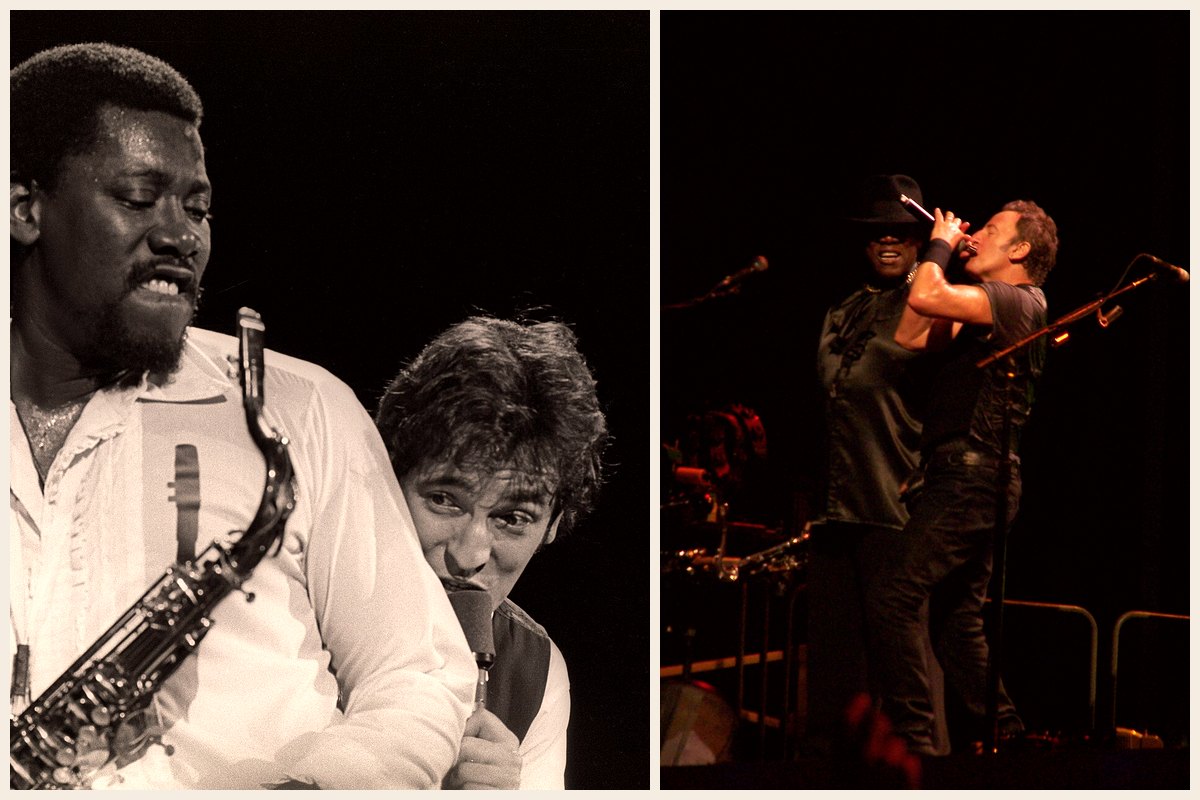
- In-article image: Clarence Clemons and Bruce Springsteen, Madison, Wisconsin by Keith Robert Wessel, CC BY-SA 4.0, via Wikimedia Commons
- In-article image: Clarence Clemons and Bruce Springsteen, Valladolid, 2009 by Manuel Martinez Perez, CC BY-SA 2.0, via Wikimedia Commons