
Forty years ago this week, on the Billboard Hot 100 dated October 25, 1986, Cyndi Lauper reached No. 1 with “True Colors.” It was a quiet, spare ballad from an artist the world knew for loud hair, thrift-shop outfits and the joyful shout of “Girls Just Want to Have Fun.” It replaced Janet Jackson’s “When I Think of You” at the top and stayed there for two weeks.
In this On This Day feature, we look at how a song written about a songwriter’s mother was turned down by another singer, how Lauper “completely dismantled” its arrangement, and how it grew into one of the best-loved anthems of acceptance in pop music. The official video is waiting for you at the end of the article.
▶️ Want to see the dark soundstage, the black flower and the newspaper skirt right now? Scroll down. The official “True Colors” video is at the end of the article.
After the Unusual Debut
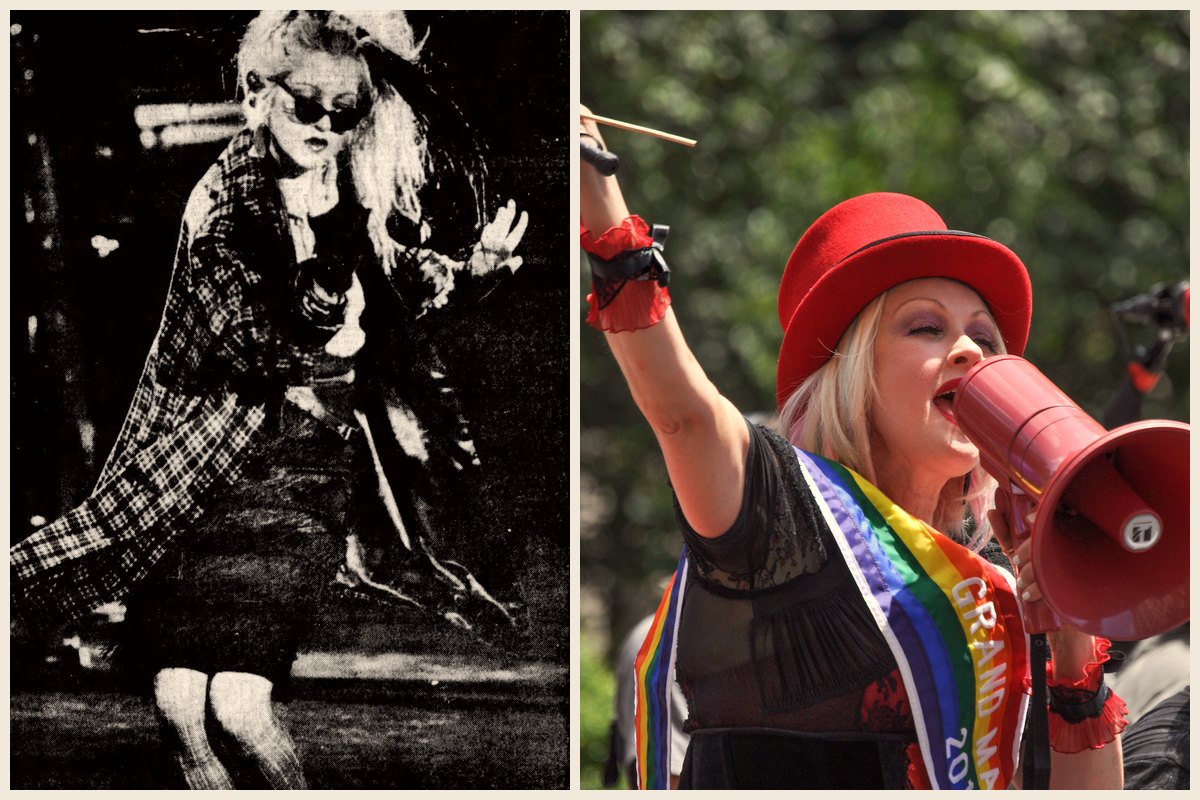
Cyndi Lauper was born in Brooklyn and grew up in the Ozone Park neighborhood of Queens. She began writing songs at 12 on an acoustic guitar her sister gave her, and her bright hair colors and unusual clothes made her stand out, sometimes painfully, at school. After years in bands, including Blue Angel, she released her solo debut, She’s So Unusual, on October 14, 1983.
That album made history. It was the first debut album by a female artist to produce four top-five hits on the Hot 100: “Girls Just Want to Have Fun”, “Time After Time,” “She Bop” and “All Through the Night.” Lauper won Best New Artist at the 1985 Grammy Awards, appeared on the covers of Rolling Stone, Time and Newsweek, and became an MTV favorite. By the end of 1985, the whole music business was waiting to see what she would do next.
A Song Written for a Mother
“True Colors” was written by Billy Steinberg and Tom Kelly, a team who had already scored a huge No. 1 with Madonna‘s “Like a Virgin” in 1984. Steinberg originally wrote the song about his own mother, and Kelly reworked the first verse. They first offered it to the Canadian singer Anne Murray, who passed on it. Then they sent it to Lauper.
It turned out to be one of the most successful partnerships of the decade. Steinberg and Kelly went on to write further No. 1 hits, including Heart’s “Alone,” Whitney Houston’s “So Emotional” and, with Susanna Hoffs, the Bangles’ “Eternal Flame.” They also wrote “I Drove All Night,” which Lauper took into the charts in 1989. The duo was inducted into the Songwriters Hall of Fame in 2011.
Their demo was a piano-based gospel ballad, in the style of Simon & Garfunkel’s “Bridge over Troubled Water.” Lauper had other ideas. “Cyndi completely dismantled that sort of traditional arrangement and came up with something that was breathtaking and stark,” Steinberg later told Songfacts. Lauper has said he had a hard time with her changes at first, but afterward he complimented her on her “exquisitely beautiful” version.
A Stripped-Down Sound
Lauper had planned to work again with Rick Chertoff, who produced her debut, but the experience was difficult and she changed her mind. Instead she produced the new album herself with Lennie Petze, and she wrote most of its songs. On “True Colors,” Peter Wood played keyboards and shared the arrangement with Lauper, John McCurry played guitar, Neil Jason played bass and Jimmy Bralower programmed the LinnDrum and added percussion.
The idea behind the record was personal. “The second album says, ‘Have the courage of your convictions and love yourself a little,’” Lauper told The New York Times in 1986. She wanted the songs “to say, ‘Love yourself,’ because we really are taught not to.” The song also meant something deeper to her: she has said it resonated because her friend Gregory Natal had recently died of AIDS.
Two Weeks at No. 1
Epic Records released “True Colors” as the album’s first single in August 1986, and the album followed on September 15. The music press was divided. Music & Media named it one of its records of the week, and Music Week found Lauper’s voice a perfect match for the “effective ballad,” while Record Mirror’s Di Cross dismissed it as “slushy.”
Listeners did not hesitate. On October 25, 1986, “True Colors” climbed to No. 1, and it held the spot for two weeks before Boston’s “Amanda” took over. It was Lauper’s second and last Hot 100 No. 1, after “Time After Time.” It also reached No. 3 in Australia and New Zealand and No. 12 in the UK, and it earned a Grammy nomination for Best Female Pop Vocal Performance. The album reached No. 4 on the Billboard 200 and has sold around seven million copies worldwide, helped by a second top-five hit, “Change of Heart.”
The Video
The video, directed by choreographer Patricia Birch, was in heavy rotation on MTV. Lauper sings on a dark soundstage beside a drum, holding a black flower. A young girl takes the flower and explores a beach, Lauper appears in a jeweled headdress with a shell in her hand, and later walks along the shore in a skirt made of newspaper. At the end she beats the drum four times, in time with the music.
An Anthem That Grew
Over the years “True Colors” became a popular anthem in the gay community. Lauper co-founded the True Colors Fund, a nonprofit working to end homelessness among LGBT young people, and launched the True Colors Tour in 2007, a multi-artist tour for the Human Rights Campaign that returned in 2008. On December 13, 2022, she sang it at the ceremony where President Joe Biden signed the Respect for Marriage Act. In 2025, Billboard ranked it No. 9 on its list of “The 100 Greatest LGBTQ+ Anthems of All Time.”
The song has been sung by many others, too. Phil Collins recorded a version produced by Babyface for his 1998 hits album, Kasey Chambers made it the theme of the 2003 Rugby World Cup, and Justin Timberlake and Anna Kendrick sang it for the 2016 film Trolls. It was also the theme for the 1988 Summer Olympics. Billy Steinberg, who wrote it with Kelly, died on February 16, 2026, and in November 2025 Lauper was inducted into the Rock and Roll Hall of Fame.
Listening Tips
- Listen for the space. Compare the spare final arrangement with Steinberg’s description of the original piano-gospel demo.
- Follow the drum. Jimmy Bralower’s LinnDrum programming and the four closing drum beats in the video frame the whole performance.
- Hear it next to her debut. Play “Time After Time” and then “True Colors” to hear how Lauper’s ballad style changed in two years.
- Try the covers. The versions by Phil Collins, Kasey Chambers and the Trolls soundtrack show how flexible the song is.
- Explore the decade. Browse more 80s Hits and Pop stories.
“True Colors” Quick Facts
| Artist | Cyndi Lauper |
| Written by | Billy Steinberg and Tom Kelly |
| Producers | Cyndi Lauper and Lennie Petze |
| Album | True Colors (September 15, 1986) |
| Single release | August 1986 |
| Hot 100 No. 1 | Chart dated October 25, 1986 (two weeks) |
| Before and after | Followed “When I Think of You” by Janet Jackson; replaced by “Amanda” by Boston |
| Other peaks | No. 3 in Australia and New Zealand; No. 12 in the UK |
| Video director | Patricia Birch |
Sources
- “True Colors” (Cyndi Lauper song) on Wikipedia (with its cited sources, including Billboard and Songfacts)
- True Colors (Cyndi Lauper album) on Wikipedia
- Cyndi Lauper on Wikipedia
- Billy Steinberg on Wikipedia
- List of Billboard Hot 100 number ones of 1986 on Wikipedia
- Billboard Hot 100, October 25, 1986
Photo Credits
- Featured image: Cyndi Lauper in a 1984 promotional photograph by John Bellissimo for Portrait Records, public domain, via Wikimedia Commons
- Featured image: Cyndi Lauper on stage, 2011 by Eva Rinaldi, CC BY-SA 2.0, via Wikimedia Commons
- Featured image: Cyndi Lauper at A&M Studios, Hollywood, January 28, 1985 by Toglenn, CC BY-SA 3.0, via Wikimedia Commons
- Featured image: Cyndi Lauper at the 2022 off-Broadway opening of Kinky Boots by Philip Romano, CC BY-SA 4.0, via Wikimedia Commons
- In-article image: Cyndi Lauper in concert, The Roanoke Times, December 3, 1984 by Wayne Deel for The Roanoke Times, public domain, via Wikimedia Commons
- In-article image: Cyndi Lauper leading the 2012 NYC Pride Parade by Bob Johnson, CC BY-SA 4.0, via Wikimedia Commons