Fifty years ago this week, on the Billboard Hot 100 dated October 23, 1976, a soft, string-laden ballad by a “rock and roll band with horns” reached No. 1 in America. The song was “If You Leave Me Now,” the band was Chicago, and after nearly a decade of hits it was their very first chart-topper. It stayed there for two weeks, then went on to top the charts in the UK, Australia, Canada, Ireland and the Netherlands.
In this On This Day feature, we look at how bassist Peter Cetera’s song was nearly left off the album, why the band’s manager ended up playing guitar on it, and how a ballad that some members feared would change the band became the song that finally won them a Grammy. The official recording is waiting for you at the end of the article.
▶️ Want to hear Peter Cetera’s soaring vocal and those lush strings right now? Scroll down. The official “If You Leave Me Now” recording is at the end of the article.
A Rock and Roll Band With Horns
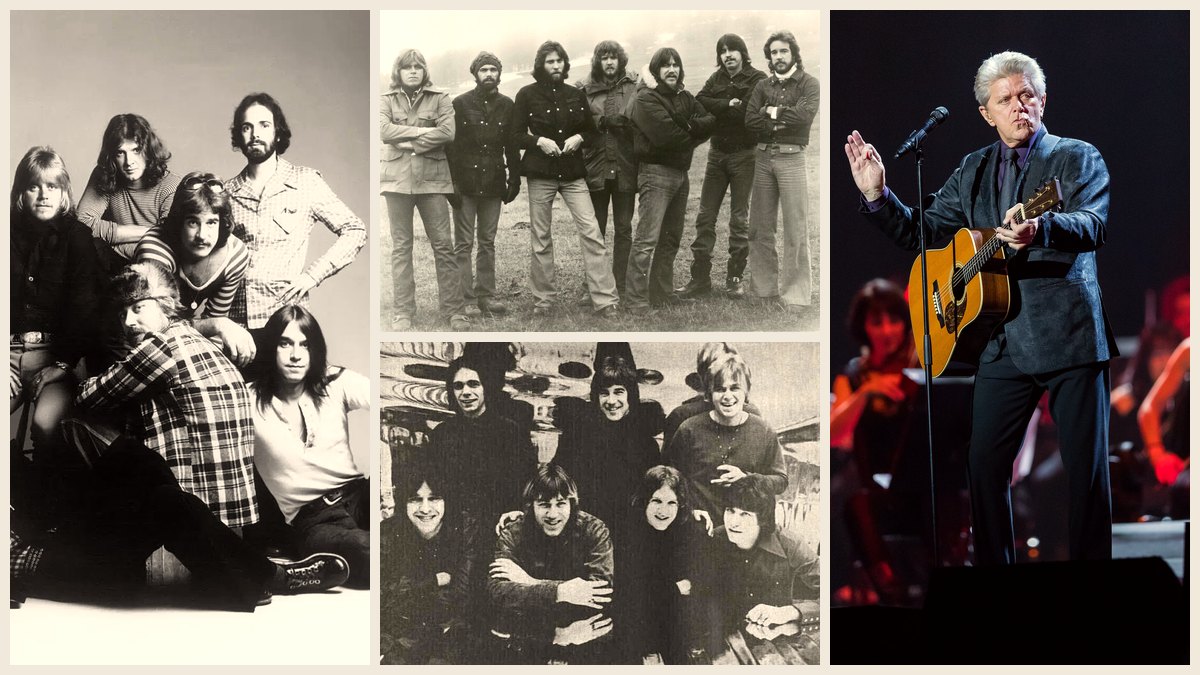
Chicago began on February 15, 1967, at a meeting of six musicians from the Chicago area: saxophonist Walter Parazaider, guitarist Terry Kath, drummer Danny Seraphine, trombonist James Pankow, trumpet player Lee Loughnane and keyboardist and singer Robert Lamm. Calling themselves the Big Thing, they played Top 40 covers in Chicago nightclubs. Late in 1967 they invited a local tenor and bass player to join, because they needed both a higher voice and a real bass sound. His name was Peter Cetera.
In June 1968, at the request of manager James William Guercio, the band moved to Los Angeles, signed with Columbia Records and changed its name to Chicago Transit Authority, later shortened to Chicago in 1969. Playing regularly at the Whisky a Go Go, they opened for Janis Joplin and Jimi Hendrix. Their records sold in huge numbers, and in 1974 the group had all seven of its albums on the Billboard 200 at the same time. Yet for all their top-ten singles, none had reached No. 1.
The Song That Almost Got Left Off
Cetera wrote “If You Leave Me Now” on guitar around the same time as “Wishing You Were Here,” a song from the 1974 album Chicago VII. The lyrics are a plea from someone trying to stop the person he loves from walking away. “How can we end it all this way?” he asks.
When the band made their next album at Caribou Ranch, the song was one of the last to be completed and, according to reports, was very nearly left off the record. The album, Chicago X, came out on June 14, 1976. It was the band’s most pop-oriented work so far, with every song running a little over three minutes, a sharp contrast to the long suites of their early double albums.

A Manager on Guitar
The recording has an unusual story. Guercio, who also produced the album, played acoustic guitar on the demo, assuming that Terry Kath would record the proper part later. But the band liked Guercio’s playing and kept it. In a 1991 booklet for the compilation Group Portrait, Cetera recalled that the track was cut live, with Cetera singing, Guercio on acoustic guitar, Kath on bass, Lamm on piano and Seraphine on drums. His vocal was later redone, and Kath overdubbed electric guitar.
That is why the Chicago X credits list Cetera on bass “except on ‘If You Leave Me Now.’” The lush sound also owes a lot to arranger Jimmie Haskell, who wrote the string and brass orchestration, and to French horn players Vince DeRosa and David Duke.
Two Weeks at No. 1
Columbia released “If You Leave Me Now” as a single on July 30, 1976. The album cover showed a partly unwrapped chocolate bar with the Chicago logo, and in the same spirit a full-page ad in Cash Box magazine pictured the single as a chocolate “kiss.” Cash Box called it “an excellent ballad,” and Record World called it “a good single choice.”
On October 23, 1976, the song replaced Rick Dees’ novelty hit “Disco Duck” at No. 1. It stayed there for two weeks before the Steve Miller Band’s “Rock’n Me” took over. It also topped the Easy Listening chart. In a year when disco was booming, it was one of only five “non-disco” songs to reach No. 1 in the U.S. over a nine-month stretch. According to PopMatters writer Zachary Houle, the song was so common on the radio that listeners in New York could reportedly hear it on four different stations at the same time.
A No. 1 in Britain, Too
Overseas it was Chicago’s biggest hit. “If You Leave Me Now” spent three weeks at No. 1 in the UK, the band’s first chart-topper there as well. Walter Parazaider later said he first heard it on the radio while cleaning his pool and thought “it sounded like McCartney,” not realizing it was his own band. By August 1978 the single had sold 1.4 million copies in the United States alone.
The Grammy, and a Change of Direction
At the 19th Annual Grammy Awards on February 19, 1977, “If You Leave Me Now” won Best Pop Vocal Performance by a Duo, Group or Chorus, Chicago’s first Grammy. Guercio and Haskell also won Best Arrangement Accompanying Vocalists, and the song was nominated for Record of the Year. Chicago X itself won the Grammy for Best Album Package for art director John Berg’s chocolate bar cover.
Not everyone in the band saw the success as pure good news. Some members felt it changed how the public saw Chicago and led Columbia to ask for more ballads. Biographer William James Ruhlmann wrote that it “consolidated” radio’s preference “for lush ballads sung by Peter Cetera over any other style the band might care to put forward.” Robert Lamm has since said the band had been moving toward the mainstream for years. Cetera went on to sing Chicago’s second No. 1, “Hard to Say I’m Sorry,” in 1982, and left for a solo career in 1985.
A Song That Keeps Coming Back
The website SecondHandSongs lists more than 130 cover versions. Boyz II Men recorded it for their 2009 album Love, and Philip Bailey of Earth, Wind & Fire sang it at the two bands’ joint concerts in the mid-2000s. It has turned up in films such as Three Kings and Shaun of the Dead, in South Park and Sex and the City, and in the video game Grand Theft Auto V.
The original lineup of Chicago was inducted into the Rock and Roll Hall of Fame in 2016, and the band received a Grammy Lifetime Achievement Award in 2020. Few soft-rock ballads of the 1970s have aged as gracefully. If you like the decade’s big slow songs, read our story of the Rolling Stones’ “Angie”, which topped the same chart three years earlier.
Listening Tips
- Listen for the French horns. Vince DeRosa and David Duke play the warm horn lines, part of Jimmie Haskell’s Grammy-winning arrangement.
- Notice the acoustic guitar. It is manager and producer James William Guercio, whose demo part was kept on the record.
- Follow Cetera’s range. According to the published sheet music, the song is in B major and his vocal climbs from F sharp 3 to D sharp 5.
- Hear the rest of the album. Chicago X also includes “Another Rainy Day in New York City” and “You Are On My Mind.”
- Explore the decade. Browse more 70s Gold and Rock stories.
“If You Leave Me Now” Quick Facts
| Artist | Chicago |
| Written and sung by | Peter Cetera |
| Producer | James William Guercio |
| Album | Chicago X (June 14, 1976) |
| Single release | July 30, 1976 |
| Hot 100 No. 1 | Chart dated October 23, 1976 (two weeks) |
| Before and after | Followed “Disco Duck” by Rick Dees and His Cast of Idiots; replaced by “Rock’n Me” by the Steve Miller Band |
| Other No. 1s | UK (three weeks), Australia, Ireland, Canada, the Netherlands; U.S. Easy Listening |
| Grammys | Best Pop Vocal Performance by a Duo, Group or Chorus; Best Arrangement Accompanying Vocalists |
Sources
- “If You Leave Me Now” on Wikipedia (with its cited sources, including Billboard and Cash Box)
- Chicago X on Wikipedia
- Chicago (band) on Wikipedia
- Peter Cetera on Wikipedia
- List of Billboard Hot 100 number ones of 1976 on Wikipedia
- Billboard Hot 100, October 23, 1976
Photo Credits
- Featured image: Chicago in a press photo dated 1975 by an unknown photographer, public domain, via Wikimedia Commons
- Featured image: Chicago, circa 1973 by Columbia Records, public domain, via Wikimedia Commons
- Featured image: Chicago Transit Authority, circa 1969 by Hit Parader magazine, public domain, via Wikimedia Commons
- Featured image: Peter Cetera at Night of the Proms, Mannheim, 2017 by Sven Mandel, CC BY-SA 4.0, via Wikimedia Commons
- In-article image: Peter Cetera at Night of the Proms, Mannheim, 2017 by Sven Mandel, CC BY-SA 4.0, via Wikimedia Commons
- In-article image: Chicago performing at Caesars Windsor, November 9, 2024 by Crisco 1492, CC BY-SA 4.0, via Wikimedia Commons
- In-article image: Chicago performing at Caesars Windsor, November 9, 2024 by Crisco 1492, CC BY-SA 4.0, via Wikimedia Commons