
If you turned on a radio in the fall of 1981, you couldn’t escape that bass line. Big, bouncy and a little bit wicked, it came roaring out of car windows, roller rinks and house parties all over America. “Super Freak” was Rick James at the very top of his game, a punk-funk showman in thigh-high boots who had just made the best-selling album of his life.
But there’s a twist to this story that a lot of fans never knew. The song had a music video, a flashy, cheeky little film made just as a brand-new cable channel called MTV was switching on. And MTV said no. What happened next turned a party record into one of the first big fights over who got to be seen on music television. Here’s the story behind the video, and why it still matters. The official clip is waiting for you at the end of this article.
▶️ Looking for the video? Scroll down. You’ll find it at the end of the article.
The Song: A Party Record With a Wink
By 1981 Rick James, born James Ambrose Johnson Jr. in Buffalo, New York, had already lived several lives. He had dodged the draft in Toronto, played in a band called the Mynah Birds with a young Neil Young, and worked behind the scenes at Motown before finally breaking through with “You and I” and “Mary Jane” in 1978. His fifth album, Street Songs, came out on Motown’s Gordy label on April 7, 1981, and it was the big one.
“Super Freak” was recorded during the Street Songs sessions between December 1980 and January 1981, at the Record Plant in Sausalito, California, and at Motown’s studios in Hollywood. James’s Motown labelmates the Temptations sang background, which delighted him: their bass singer Melvin Franklin was one of his heroes. Oscar Alston played that famous bass part, and Daniel LeMelle of James’s Stone City Band blew the sax solo.
James reportedly wasn’t especially excited about the song at first. According to the story he liked to tell, he simply wanted something on the album that “white folks could dance to.” Los Angeles DJ Alonzo Miller helped tone down some of James’s improvised lyrics and earned a co-writing credit for his trouble.
Making the Video
Motown had been slow to take music video seriously. The company’s video department was only set up in early 1979, under vice president Nancy Leiviska, one of the record industry’s early video pioneers. James’s brother and manager, LeRoi Johnson, pushed hard for a real video budget, and after Street Songs took off, Motown agreed to pay for clips for “Give It to Me Baby” and “Super Freak.”
James came up with the concepts himself and brought in director Nick Saxton, a veteran who had already made videos for Michael Jackson and Pat Benatar. The “Give It to Me Baby” clip was shot in a rented house in Trousdale, but “Super Freak” was filmed at A&M Records in Los Angeles. Leiviska later said that Motown staffers had to fill in for the chorus, so she appears in the video herself, along with Terry Gordy and his wife, attorney Desiree Gordy.
It wasn’t the calmest of shoots. Leiviska recalled years later that James was so high on the day that the extras had to be sent home. You’d never guess it from the finished film, which is pure early-’80s swagger: James in his braids and boots, a gang of glamorous dancers, and a lot of winking at the camera.
Why MTV Turned It Down
MTV signed on on August 1, 1981. On that very day, Street Songs was the third biggest-selling album in the country. You might think a channel built on music would want the hottest act of the summer. Instead, MTV programmed itself as a rock station, and that format left out almost every Black artist on the charts, Rick James included.
James pitched the “Super Freak” video, and MTV passed. At a Billboard music video conference in New York that fall, he went off the careful script his publicist, Ramon Hervey II, had prepared and accused the network of racial bias. He repeated the charge to the Los Angeles Times, and later took the fight to ABC’s Nightline. MTV’s founder Bob Pittman replied that the decision was about sound, not race, saying audiences didn’t define James as rock.
There was another side to it, too. Carolyn Baker, MTV’s original head of talent and acquisition and its lone Black executive, later said that she was the one who turned the video down, because of the half-dressed women in it. As a Black woman, she said, she did not want that clip to be the first Black video on MTV. Both things can be true at once, and that is part of what makes this story so interesting.
What Happened Next
James lost the battle, but the argument he started didn’t go away. In 1983, David Bowie challenged MTV VJ Mark Goodman on the air about how few Black artists the channel played. That same year, CBS Records pushed MTV to add Michael Jackson’s “Billie Jean,” which premiered on March 10, 1983 and went into heavy rotation. You can read that side of the story in our feature on the making of the “Billie Jean” video.
James himself didn’t appear on MTV until a couple of years later, with Eddie Murphy’s “Party All the Time,” a hit he wrote and produced. It’s one of the music business’s little ironies that the man who knocked hardest on MTV’s door got in only through someone else’s video.
How “Super Freak” Did on the Charts
- It reached No. 16 on the Billboard Hot 100, James’s biggest crossover single, and topped Billboard’s dance chart in 1981.
- According to Motown historian Adam White, the single sold about 900,000 copies in the U.S. without ever cracking the pop Top 10.
- Street Songs spent 20 weeks at No. 1 on the R&B albums chart, reached No. 3 on the pop chart and was certified platinum by July 1981.
- At the 1982 Grammys, “Super Freak” was nominated for Best Male Rock Vocal Performance, making James the first African American artist nominated in that category.
- Rolling Stone ranked it No. 153 on its 2021 list of the 500 Greatest Songs of All Time.
Why It Still Grooves
A big part of the song’s second life came in 1990, when MC Hammer built “U Can’t Touch This” on the “Super Freak” riff. James and Alonzo Miller sued for a songwriting credit, and all three men ended up sharing the Grammy for Best R&B Song in 1991. Jay-Z, the Black Eyed Peas and Nicki Minaj, with her 2022 hit “Super Freaky Girl,” have all borrowed from it since.
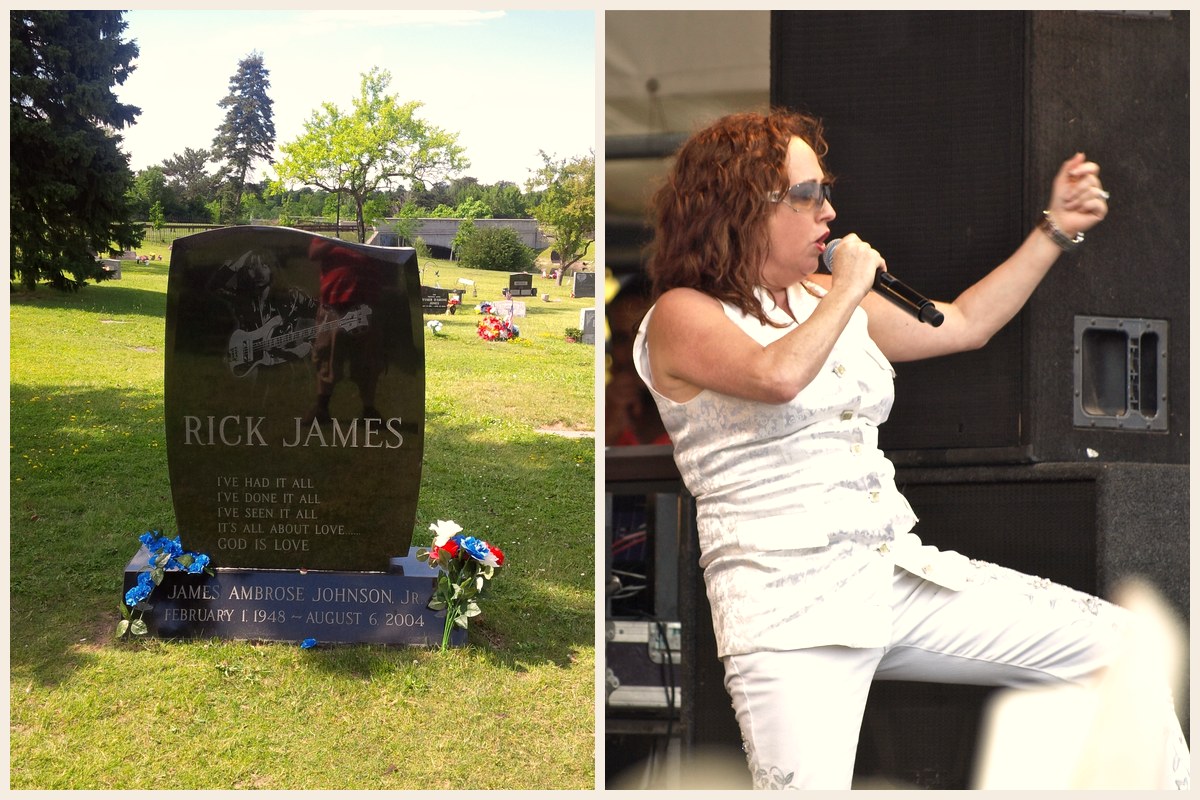
But the original still sounds best. Those Temptations harmonies, the sly vocal and the bass line you can feel in your chest are a snapshot of a moment when funk, rock and new wave were all mixing on the same dance floor. James, who died in 2004 at 56, was buried in his hometown of Buffalo, where some 6,000 fans turned out for his public funeral.
Listening Tips
- Start with the album. Street Songs (1981) plays beautifully front to back, from “Give It to Me Baby” to the slow-burning Teena Marie duet “Fire and Desire.”
- Go live. The 2001 deluxe edition of Street Songs adds a full concert recorded at Long Beach, California, on July 30, 1981, including a hot live “Super Freak.”
- Hear the 12-inch. The seven-minute extended version gives that groove plenty of room to stretch.
- If you like this, try: the Mary Jane Girls’ “All Night Long,” which James produced, Teena Marie’s “Square Biz,” and more of the decade in our 80s Hits and Disco & Funk sections.
Fun Facts
- The Temptations get a shout-out in the song itself, right before they come in on backing vocals.
- Canadian singer Taborah Johnson also sang background on the track.
- MTV’s rejection of “Super Freak” is often cited as one of the first public battles over race on music television.
- In 2006, the Dutch group Beatfreakz took a cover of the song to No. 7 in the UK.
“Super Freak” Quick Facts
| Artist | Rick James |
| Written by | Rick James, Alonzo Miller |
| Album | Street Songs (April 7, 1981) |
| Label | Gordy Records (Motown) |
| Recorded | December 1980 to January 1981, Sausalito and Hollywood |
| Backing vocals | The Temptations, Taborah Johnson |
| Video director | Nick Saxton |
| Billboard Hot 100 peak | No. 16 |
| Grammy nomination | Best Male Rock Vocal Performance (1982) |
| Famous sample | MC Hammer, “U Can’t Touch This” (1990) |
Want more stories from behind the camera? Browse our Behind the Video series.
Sources
- “Super Freak” on Wikipedia (with its cited sources)
- Street Songs on Wikipedia
- Rick James on Wikipedia
- Adam White: “Rick to the Rescue” (interview with Motown video chief Nancy Leiviska)
- Literary Hub: Ramon Hervey II, “When Rick James Fought to Get Black Artists on MTV”
Photo Credits
- Featured image: Hitsville U.S.A., Motown’s original headquarters in Detroit by Blob4000 (Chris Butcher), Public domain, via Wikimedia Commons
- Featured image: The Record Plant (The Plant) studio, Sausalito, California by Binksternet, CC BY-SA 3.0, via Wikimedia Commons
- Featured image: Buffalo, New York, waterfront skyline by Reading Tom, CC BY 2.0, via Wikimedia Commons
- Featured image: Hammond B3 organ in Hitsville U.S.A. Studio A by Global Reactions, CC BY 2.0, via Wikimedia Commons
- In-article image: Rick James’s grave, Forest Lawn Cemetery, Buffalo by Jfvoll, CC BY-SA 4.0, via Wikimedia Commons
- In-article image: Teena Marie performing, 2010 by William Morgan, CC BY-SA 2.0, via Wikimedia Commons